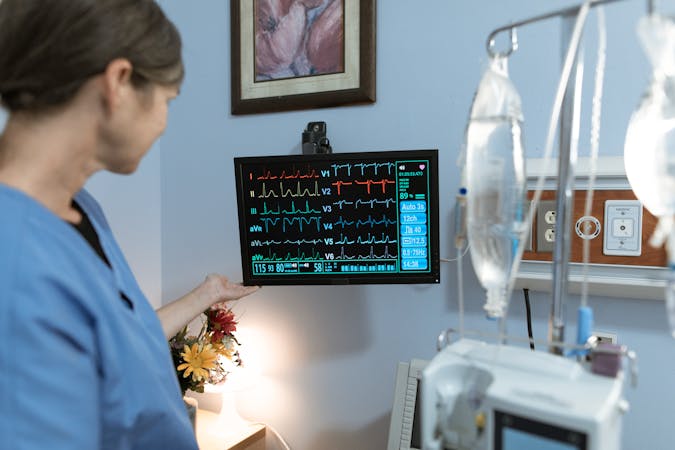
The ICU is where nursing gets real. It’s where the sickest patients land — the ones on vents, the ones whose numbers are trending the wrong way, the ones whose families are standing in the hallway not sure what to say. ICU nurses are the ones holding it all together.
If you’ve ever thought about critical care nursing, this guide covers what the specialty is actually like, the skills you’ll need, how to break in as a new nurse or experienced nurse looking to transition, and what the career path looks like.
What ICU Nurses Actually Do
In the ICU, you’re typically caring for 1–2 patients per shift — compared to 4–6 on a med-surg floor. But don’t let that ratio fool you. Each of those patients is critically ill, often on multiple drips, vents, or invasive monitoring lines, and requires near-constant assessment.
On any given shift you might be managing a septic patient on vasopressors, titrating a propofol drip, troubleshooting a ventilator alarm, inserting an arterial line, or running a code. You’ll also be the primary communicator for families who are scared and need someone to trust.
ICU nursing demands an advanced understanding of pathophysiology. You need to know not just what the numbers say but what they mean — and why they’re changing.
Types of ICUs
Not all ICUs are the same. Choosing the right one matters for your career path and daily experience:
Medical ICU (MICU): Patients with severe medical conditions — sepsis, respiratory failure, multi-organ failure. Heavy on drips, vents, and complex disease management.
Surgical/Trauma ICU (STICU/TICU): Post-surgical and trauma patients. Fast-paced, procedurally rich, high acuity. Common in Level 1 trauma centers.
Cardiac ICU (CICU): Post-cardiac surgery, cardiogenic shock, heart failure. Hemodynamic monitoring is a big part of this role.
Neurological ICU (Neuro ICU): Strokes, TBIs, intracranial bleeds, and seizure disorders. Strong neuro assessment skills required.
Pediatric ICU (PICU): Critically ill children. Requires both clinical expertise and the emotional resilience to care for pediatric patients and their families.
What ICU Nurses Actually Make
ICU nurses are among the higher-paid nursing specialties. In 2026, the national average salary for a staff ICU RN runs between $85,000 and $115,000 per year, with significant variation by state and facility type.
California ICU nurses can earn upwards of $130,000+, while travel ICU nurses on 13-week contracts often take home $2,500–$4,000 per week depending on location, agency, and demand. The ICU experience that feels grueling in year one becomes the credential that opens every door in nursing — travel, flight nursing, CRNA school, management.
How to Get Into the ICU
The path into the ICU has changed significantly. A few years ago, new grads almost never went straight to critical care. Today, many hospitals actively recruit new grads into their ICU residency programs.
As a new grad: Look for ICU residency programs at large academic medical centers and Level 1 trauma centers. These programs typically run 6–12 months and include classroom training, simulation lab time, and a long preceptorship. Acceptance is competitive — having a BSN, critical care clinical experience, and ACLS certification helps.
As an experienced nurse: Med-surg, step-down, or PCU experience is the traditional bridge. One to two years of floor experience builds your assessment skills and clinical instincts before you’re managing a vented patient with five drips. Step-down units are especially good preparation because you’re already managing higher-acuity patients.
Essential ICU Nursing Skills
To thrive in the ICU, you’ll need to develop competency in:
Hemodynamic monitoring: Arterial lines, central venous pressure, Swan-Ganz catheters. Understanding MAP, CVP, CO, and what they’re telling you about your patient’s physiology.
Mechanical ventilation: Reading vent settings, understanding modes (AC, SIMV, PSV, CPAP), recognizing ventilator-associated problems, and being able to speak intelligently with respiratory therapy.
Vasoactive drips: Norepinephrine, vasopressin, dopamine, dobutamine, epinephrine — knowing when they’re used, how to titrate them, and what side effects to watch for.
Critical care pharmacology: Sedation protocols, paralytic agents, insulin drips, antibiotic stewardship. The ICU is heavy on pharmacology knowledge.
Code management: ACLS certification is required in virtually every ICU. Knowing your role during a code — and being able to think clearly in that moment — is non-negotiable.
The CCRN Certification
The CCRN — Critical Care Registered Nurse credential — is the gold standard for ICU nurses. Offered by AACN, it validates your expertise in adult critical care and carries real weight in salary negotiations and career advancement.
Eligibility requires 1,750 hours of direct care of critically ill patients within the last two years, with 875 of those hours in the most recent year preceding application. Most ICU nurses pursue their CCRN after 1–2 years in the unit.
Having your CCRN can translate to a pay bump of $2–5/hour at many facilities, plus it opens doors for flight nursing, CRNA school applications, and leadership roles.
What This Means for Nurses Considering Critical Care
ICU nursing is not for everyone — and that’s okay. The emotional weight is real. You will lose patients. You will be the one who has to tell a family that nothing more can be done. You’ll carry some of those moments home with you.
But for nurses who want to operate at the highest level of clinical complexity, who want to truly understand the human body under siege, and who find meaning in being present during the most critical moments of a person’s life — the ICU is extraordinary.
If you’re considering it, shadow in an ICU first. Talk to nurses who work there. Apply for a residency program. The learning curve is steep, but the nurses who make it through say the same thing: they can’t imagine working anywhere else.
Leave a Reply